7 Legislative Changes Canadian Restaurant and Hospitality Operators Need on Their Radar Right Now
You budgeted for the minimum-wage increase months ago. You probably didn't budget for the recruiter-licensing law that arrived through an immigration act.
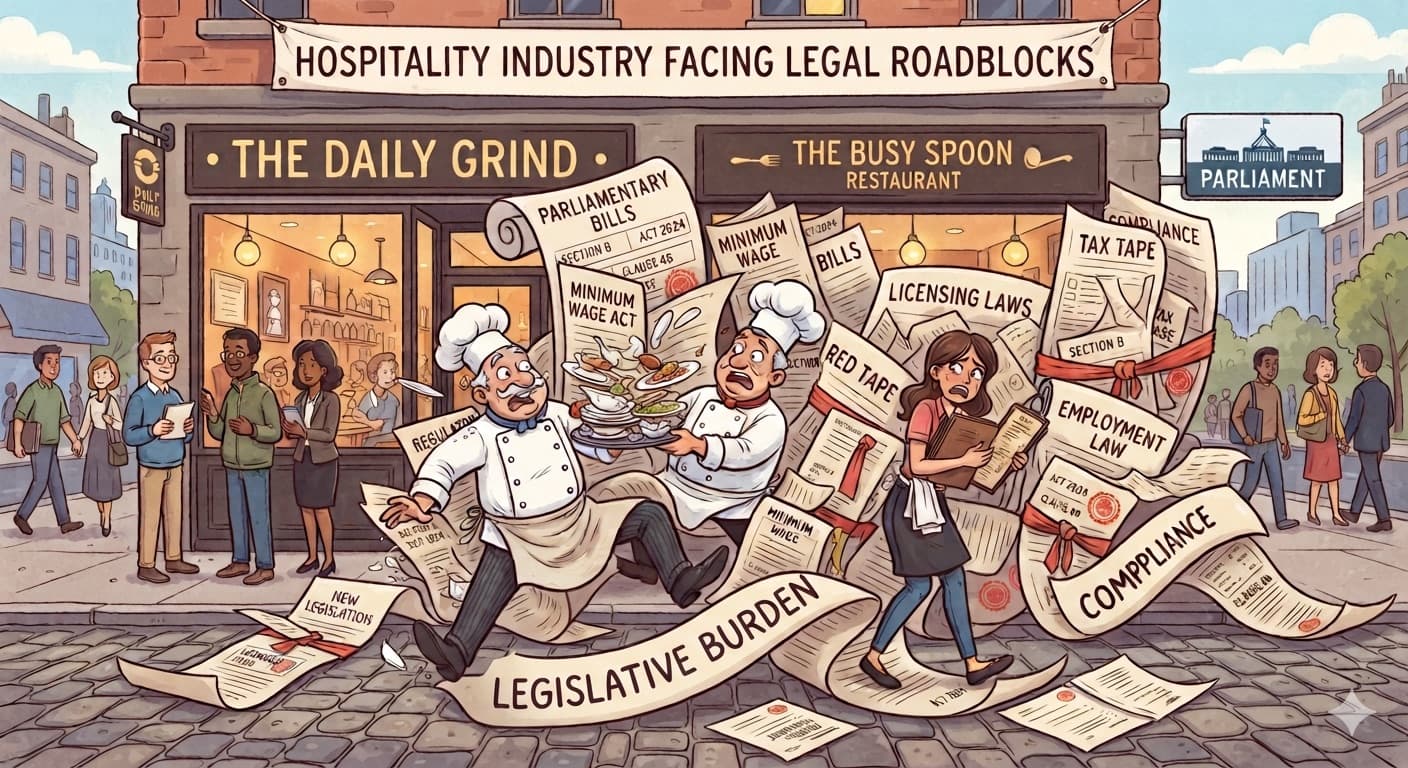
Bills from six legislatures — and the ones that bite don’t arrive through a restaurant newsletter.
Every operator in the country has the wage math done. BC went to $18.25 on June 1, the other provinces post their numbers on schedule, and you've had months to work the increase into menu pricing and scheduling. It's a cost, but it's a cost you saw coming from a long way off. That part is priced in.
What isn't priced in is a law Alberta passed under the title Immigration Oversight Act. If you hire foreign nationals, you now register with the province. If you use a recruiter or an immigration consultant, they now need a provincial licence — and if they don't have one, that's your problem too, inside a regime carrying fines up to $1.5 million. Nobody ran that as a hospitality headline, because on paper it's an immigration story.
That's the shape of this year. Bills in Ottawa, Edmonton, Toronto, Victoria, Fredericton, and Quebec City are changing who controls the tip pool, what training your staff must take, how alcohol can be labelled and promoted, what your final bill is allowed to say, and what it takes to legally hire a foreign worker — and almost none of them will reach you through a restaurant newsletter.
Here are seven bills a small operator should actually be watching — with their real, current status.
A quick decoder first, because legislatures don't speak plain English: Royal Assent means a bill has passed — it's law. Third Reading is the final vote in a chamber. Second Reading means it's being actively debated — real momentum, but not law. First Reading means it's only just been introduced — a proposal that may never go anywhere. Only one of the nine bills below is law today — but "not law yet" is exactly when you can still do something about it.
1. Alberta wants an $18 minimum wage — and your tip pool written into statute
Bill 201, Employment Standards (Protecting Workers' Pay) Amendment Act — Second Reading, Alberta (in debate, not law yet)
This private member's bill would raise Alberta's minimum wage in steps to $18 by 2027, then tie increases to inflation. The number will get the coverage. Two other provisions matter more.
The first: employers would be required to pass tips and gratuities directly to workers. If your tip-out is a straight distribution among staff, nothing changes. If any portion routes through the house — to cover card processing, breakage, or back-of-house wages — that arrangement is what the provision is aimed at. The second: lower minimum wages based on age or student status would be banned outright, which removes a rate that a lot of Alberta operators have built their entry-level scheduling around.
What to do
The odds are longer than a government bill's — but it reached Second Reading. Model labour costs at $18 with no student rate, and look at your tip-out structure now: if any of it routes through the house, that's the exposed part.
2. Hiring foreign workers in Alberta now means registering with the province — this is law
Bill 26, Immigration Oversight Act — Royal Assent, Alberta (this is law)
This is the law from the top of this article, and it's the one genuine done deal on the list. Alberta requires employers who hire foreign nationals to register with the province, and requires foreign-worker recruiters and immigration consultants to hold a provincial licence — with fines up to $1.5 million.
Food service and hospitality lean on the Temporary Foreign Worker program more than almost any other industry, and most operators who use it don't recruit directly — they use an agency. That agency relationship is now a compliance surface. You have a provincial layer stacked on top of the federal one, and a vendor whose licensing status is suddenly your business.
What to do
Confirm your registration obligation and audit your recruiter relationships — an unlicensed recruiter is now your problem too.
3. Ontario would mandate harassment-prevention training in every licensed establishment
Bill 88, Safe Night Out Act — First Reading, Ontario (a proposal for now)
This bill would require sexual violence and harassment prevention training for workers in liquor-licensed establishments, and strengthen the Occupational Health and Safety Act to explicitly address workplace sexual violence. If it passes, every bar and licensed restaurant in Ontario has a new onboarding requirement and a new compliance record to keep — in an industry that turns over a meaningful share of its staff every year.
What to do
Watch-and-brief. If it moves past committee, budget for training time and pick a provider early — mandate deadlines have a way of creating vendor bottlenecks.
4. The Senate is moving on alcohol twice: cancer warnings and a near-total promotion ban
Bill S-202 — Third Reading in the Senate (one vote from clearing it); Bill S-203 — Second Reading (in debate, not law yet)
S-202 would require warning labels on all alcoholic beverages — standard drink counts, consumption limits, and a message about the causal link between alcohol and fatal cancers. It's one vote from moving to the Commons.
S-203 goes much further: it would prohibit virtually all promotion of alcoholic beverages, with narrow exceptions. Sit with the word "promotion" for a second and count what it covers in your operation — the happy-hour board, the feature cocktail on the Instagram story, the sponsorship of the local team, the wine dinner email. All of that lives inside promotion.
What to do
Senate public bills move slowly and often die — but S-202 is further along than most people realize. Know which of your marketing would be caught if S-203 ever moves.
5. "The advertised price is the price" is about to be Alberta law
Bill 209, Consumer Protection (Affordability Measures) Amendment Act — Second Reading, Alberta (in debate, not law yet)
This bill would ban charging consumers more than the advertised price, with limited exceptions. For hospitality, that's the live wire. Walk the path a guest actually walks: the price on the menu, then the number on the bill. If a service charge, a mandatory large-party gratuity, or a kitchen-appreciation fee sits between those two numbers, that gap is precisely what this bill targets.
What to do
Audit the path from menu to final bill. If a mandatory fee isn't in the printed price, decide now whether to fold it in or disclose it where the price is first advertised.
6. A national food-allergy framework is coming
Bill S-247 — Second Reading in the Senate (in debate, not law yet)
This bill would require a national framework on food allergy — covering prevention, epinephrine access, accurate ingredient labelling, and public awareness. A framework bill doesn't impose obligations on operators directly, but it's the standard first step before labelling and disclosure rules tighten.
What to do
Treat your allergen documentation as if disclosure rules were already stricter. It's cheap now and expensive retroactively.
7. The good news: two provinces want to cut income taxes for your youngest staff
Ontario Bill 127 and BC Bill M 245 — both at First Reading (proposals for now)
Ontario's Fair Start for Young Workers Act would eliminate provincial income tax on the lowest bracket for residents under 27 starting with the 2027 tax year; BC has a private member's bill on the same theme. No industry employs more young people than food service and hospitality — if either passes, your entry-level staff take home more without a dollar of it coming through your payroll. That is a recruiting advantage handed to you for free, which is not a sentence that appears often on a list like this.
What to do
Nothing — except remember these exist when you're writing job postings in 2027.
The pattern behind all seven
Look at where these bills live: three of the seven are Alberta bills, two are Senate bills most operators have never heard of, and the training mandate hides inside a bill called "Safe Night Out." The one item on this list that is already law, already enforceable, and already carrying seven-figure fines is the one that arrived through an immigration act — and an Alberta operator doing everything right, tracking every wage announcement, would have missed it. The changes that actually blindside operators rarely announce themselves.
And those are only the bills this article had room for. Quebec just banned the sale of energy drinks to minors through a health bill; New Brunswick opened farmers' market sales to craft brewers and small distillers through a liquor amendment. Every province is moving — the question is which movements reach your counter.
Nobody running three locations has time to read order papers from six legislatures, let alone the consumer-protection and immigration dockets where the real surprises hide. That's how operators end up learning about a rule from the inspector enforcing it.
This article is general information, not legal or tax advice. Bill statuses are accurate as of September 5, 2026, and bills at First or Second Reading can change substantially before passage. Consult a professional for advice on your situation.