7 Legislative Changes Canadian Builders and Trades Need on Their Radar Right Now
Everyone in the industry read the code changes. Almost nobody read the transit bill that rewrites lien and holdback rules — or the labour omnibus that shortens union certification on your site.
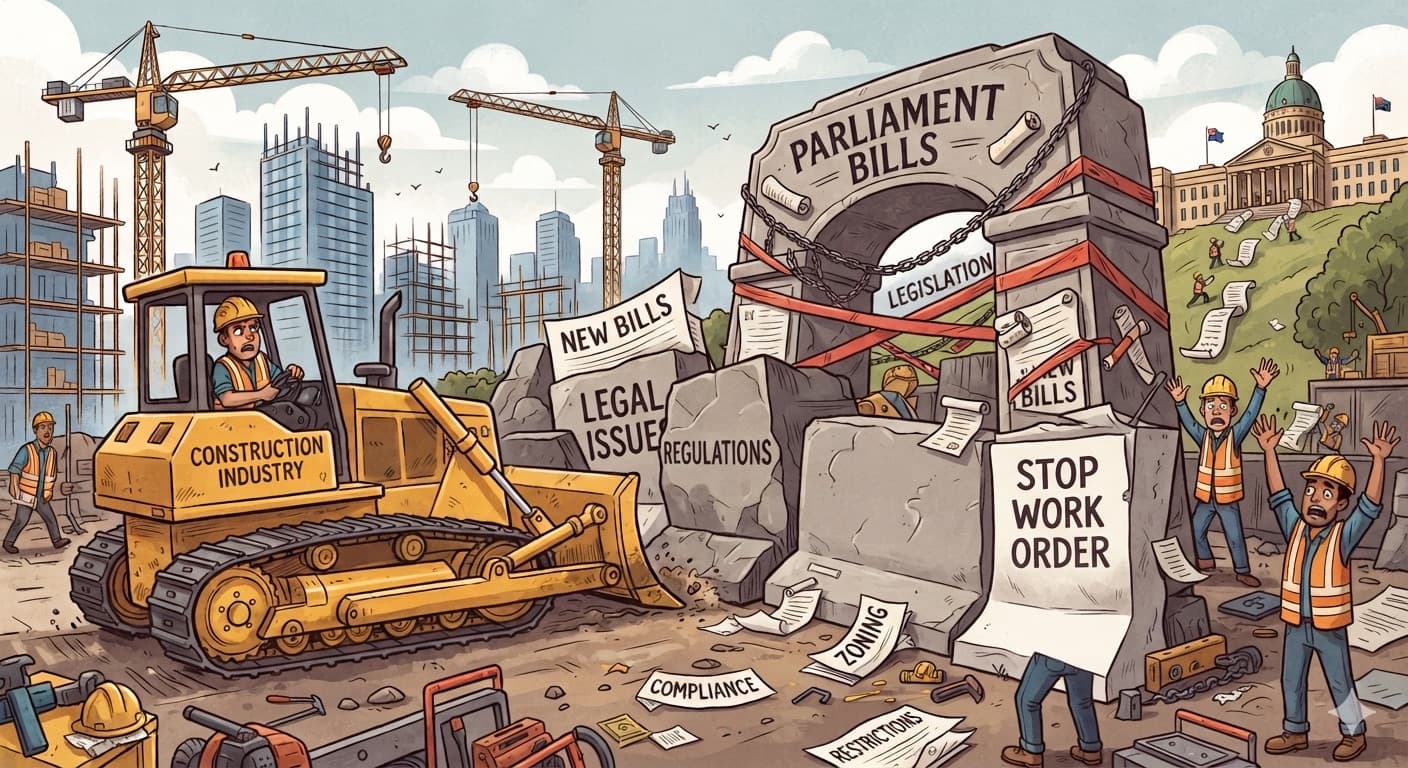
Thirteen bills, seven legislatures — and the ones that bite aren't labelled 'construction'.
Ontario's 2024 building code revised more than 1,700 items — the largest single code change in the province's history — and the National Building Code 2025 is being adopted province by province through 2026, the first edition with climate requirements built in. If you build in Canada, somebody in your office has spent two years reading code bulletins.
Meanwhile, an omnibus bill named after infrastructure delays passed into law in Ontario. Buried in the middle of it: amendments to construction lien and holdback rules. Which is to say, amendments to when the money you are owed becomes money you can actually collect. No one publishes a bulletin about that.
Codes tell you how to build. Bills moving through Ottawa, Toronto, Victoria, Edmonton, Fredericton, and Halifax decide how you get paid for it, what your WSIB bill looks like, who can certify a union on your site, and which provinces your ticket works in.
Here are seven bills a small builder or trades contractor should actually be watching — with their real, current status.
A quick decoder first, because legislatures don't speak plain English: Royal Assent means a bill has passed — it's law. Second Reading means it's being actively debated — real momentum, but not law. First Reading means it's only just been introduced — a proposal that may never go anywhere. Ten of the thirteen bills below are already law, most of them as of this summer; the rest are proposals at different stages — which is exactly when preparing for them is cheapest.
1. Ontario changed the rules on liens and holdbacks — the get-paid layer
Bill 60, Fighting Delays, Building Faster Act — Royal Assent, Ontario (this is law)
This is the bill from the top of this article. It's pitched as an infrastructure accelerator — the announcement is about getting transit and housing projects out of the ground faster. Buried in the middle are amendments to construction lien and holdback rules.
For a trade contractor, that middle section is the business. Lien and holdback rules decide when the money owed to you is protected, when holdback has to be released, and what recourse you have when someone up the chain doesn't pay. Every contractor who has waited out a 45-day holdback release on a job where the general was already slow-paying knows exactly how much those timelines are worth. This bill moves them — and it passed exactly the way it was introduced, as a transit story.
What to do
This is law now. Ask your trade association exactly how the holdback amendments change release timing and when they take effect — then update your payment terms with that answer in hand.
2. Development charges and approvals have been reshaped in Ontario — twice
Ontario Bills 17 and 98 — both Royal Assent (this is law)
Two separate bills have rewritten the economics of getting a project out of the ground: Bill 17 reforms development charges, streamlines municipal approvals, and reduces setback requirements; Bill 98 removes development barriers and cuts municipal red tape for builders. Both are now law: the charges you pass through and the approval timelines you quote are changing — and any 2027 number you've already given a client was priced under the old rules.
What to do
If you build or subcontract in Ontario, get the final development-charge rules in front of you before locking in pricing on 2027 work — numbers quoted under the old regime need a second look.
3. Ottawa just became a housing developer with $11.5 billion
Bill C-20, Build Canada Homes — Royal Assent, federal (this is law)
This one is law — and as of late July, operational. The Canada Gazette confirmed the Act's provisions are in force, and the Minister of Infrastructure and Communities has been designated as the responsible minister. Build Canada Homes is a new federal Crown corporation with up to $11.5 billion to increase affordable housing supply. It can develop land, construct homes, provide financing, and partner with private entities.
Read the mandate language closely, because it's doing work: the corporation is directed to promote "innovative and efficient construction methods." That is the federal government spelling out modular and prefab without saying modular and prefab. A very large new buyer just entered the market with a named minister, an active mandate, and a stated preference about how it wants things built.
What to do
Build Canada Homes is now active — watch its procurement channels. If you do modular, panelized, or prefab work — or want to — this is the lane opening up.
4. Your ticket travels now: trades credential recognition is going national
BC Bill 5 (law), Alberta Bill 21 (law), New Brunswick Bill 33 (law), Nova Scotia Bill 36 (law), Saskatchewan Bill 24 (law), federal Bill C-266 (in debate, not law yet)
Five provinces and a federal framework bill are dismantling the provincial walls around trades credentials and materials:
- BC's Bill 5 — the Trade Recognition Act — makes goods and services legally sold or supplied in another province sellable and suppliable in BC. Law since spring 2026.
- Alberta's Bill 21 — recognizes out-of-province goods, services, and worker credentials, so workers licensed elsewhere in Canada can work in Alberta without re-qualifying. Royal Assent, March 2026.
- New Brunswick's Bill 33 — recognizes apprenticeship credentials from other provinces and waives registration fees for out-of-province apprentices.
- Nova Scotia's Bill 36 — the Free Trade and Mobility within Canada Act lets workers licensed in another province work in Nova Scotia without re-qualifying.
- Saskatchewan's Bill 24 — mutual recognition of goods, services, and credentials approved in other Canadian jurisdictions.
- Federal C-266 — would require a national framework to harmonize skilled trades certifications across provinces. Still at Second Reading.
Five of those six are already law. The re-qualification wall that kept your crew from taking work one province over came down in province after province while everyone was reading code bulletins.
What to do
Re-check which provinces now recognize your certifications and your suppliers' products. If a labour shortage has kept you out of a market, the math may have changed.
5. Ontario's labour omnibus quietly touches WSIB, uniforms, and union certification on your site
Bill 105, Protecting Ontario's Workers and Economic Resilience Act — Committee, Ontario (past the main debate, not law yet)
This bill amends nine statutes, and three of those amendments land on construction employers: WSIB loss-of-earnings benefits rise from 85% to 90%, employers are banned from charging staff for uniforms, and union certification timelines in the construction industry get shorter.
That third one is the sleeper. Nothing in the bill's title says construction, and nothing in the coverage will either — it's a nine-statute labour omnibus, and the headline will be the WSIB number. But a shortened certification window changes how quickly an organizing drive on your site becomes a certified bargaining unit, which is a materially different situation for a non-union contractor than it was last year.
What to do
Non-union contractors should understand the shortened certification window; everyone should model the WSIB benefit increase into premium expectations.
6. Safety enforcement has shifted to tickets-first
Bill 30, Working for Workers Seven Act — Royal Assent, Ontario (this is law)
Ontario's seventh "Working for Workers" bill adds new administrative penalties for workplace safety violations and increases WSIB penalties. The mechanism matters more than the amounts: an administrative penalty is a fine that arrives without a prosecution, the way highway enforcement writes tickets. No charge, no court date, no opportunity to fix it first — the inspector writes it and it's yours. The bill also allows extended lay-offs by agreement, which matters to seasonal trades.
What to do
If your site documentation couldn't survive an inspector empowered to fine on the spot, fix it now — this is law.
7. Stolen copper is on Parliament's docket
Bill C-271 — Introduced, federal (an idea on the table, nothing more yet)
A private member's bill would create new Criminal Code offences for trafficking in scrap metal obtained through crime and for mischief against essential infrastructure. Full disclosure: the odds of passage are long. But metal theft off job sites is a real line item, and if a traceability regime for scrap metal emerges, it changes what recyclers can buy — and what stolen material is worth.
What to do
Nothing required. Watch it as a bellwether, and keep documenting metal inventory on site — it's what makes a theft claim stick.
The pattern behind all seven
Look at where these bills live: the lien and holdback changes are inside a transit-acceleration bill, the union-certification change is inside a nine-statute labour omnibus, and the credential wins are spread across five provincial trade and apprenticeship acts and a federal framework bill — each at a different stage, each on its own clock. Not one of the thirteen has "construction" in the title. The only document that reliably said "construction" on the cover was the code book, and the code book is the one thing the whole industry already read.
And those are just bills. Federal regulations published in the Canada Gazette — like the surtaxes on imported steel goods and wood cabinet products that landed this summer — change your material costs without ever seeing the inside of a legislature.
Nobody at a 10-person contractor has time to read order papers from seven legislatures, let alone the labour and procurement dockets where the real surprises hide. That's how builders end up learning about a rule from the inspector enforcing it.
This article is general information, not legal advice. Bill statuses are accurate as of September 5, 2026, and bills at First or Second Reading can change substantially before passage. Consult a professional for advice on your situation.