7 Legislative Changes Canadian Farmers and Food Producers Need on Their Radar Right Now
You watch trade, because everyone does. Meanwhile a committee spent haying season touring farm country with a bill that changes who is allowed to own farmland.
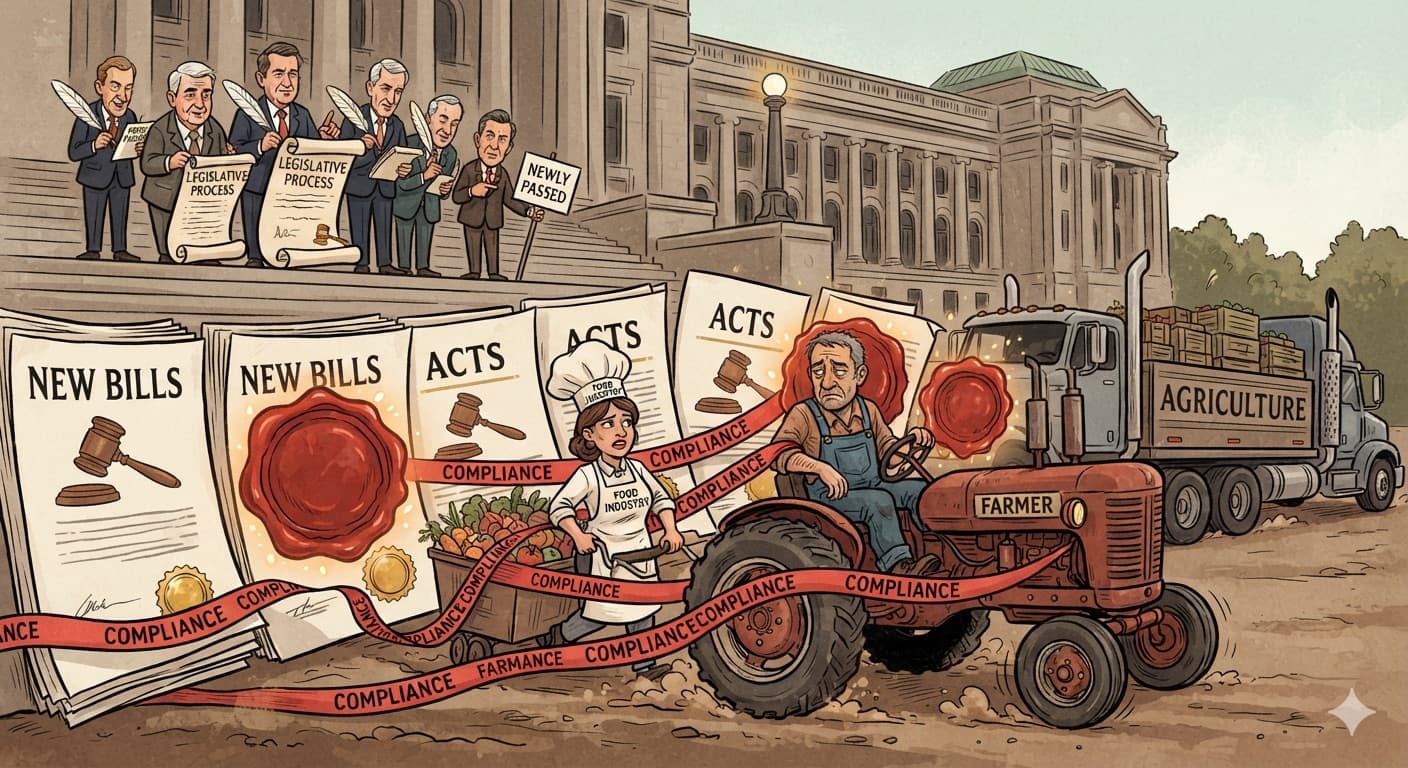
Seventeen bills, seven legislatures — and more than half are already law.
If you farm, ranch, or produce food in Canada, you watch trade. Tariff threats, retaliation lists, export markets that open and close faster than a growing season — you can't control any of it, and you follow it anyway, because everybody does.
Through late July and early August, while most of the country was in the middle of haying, a committee of the Ontario legislature was running public hearings in small-town committee rooms across farm country. The bill in front of it would ban foreign nationals from buying farmland, rewrite beef and dairy marketing rules, and change the payment protections that decide what happens to you when a buyer doesn't pay. The hearings wrapped on August 12. Amendments are still being written.
That's the harder thing to watch, and it's the whole point of this list. Bills in Ottawa, Toronto, Edmonton, Victoria, Regina, and Halifax are changing who can buy farmland, how water licences work, what it takes to legally hire a seasonal foreign worker, and how the inputs you rely on get approved — and the biggest of them did its most consequential work in the busiest weeks of your year.
Here are seven changes a producer should actually be watching — with their real, current status.
A quick decoder first, because legislatures don't speak plain English: Royal Assent means a bill has passed — it's law. Committee means a bill passed the main debate and is being studied line by line — it's also where public hearings happen and where amendments get made. Second Reading means active debate; First Reading means it's only just been introduced. Eleven of the seventeen bills below are already law — and the biggest of the rest just wrapped two weeks of committee hearings across Ontario farm country.
1. Ontario's biggest farm bill in years just finished hearings across farm country
Bill 109, Protecting Ontario's Food Independence Act — Committee, Ontario (past Second Reading, not law yet)
This is the bill from the top of this article. The headline is a Farmland Security Act banning foreign nationals and foreign-controlled entities from buying farmland, plus an expansion of farming in the northern Clay Belt. That's the part that got covered.
The back half of the bill is where most producers actually live. It rewrites the rules on beef marketing, dairy, food safety, the Ontario Food Terminal, and farmer payment protections — the machinery that determines how your product gets to market and whether you get paid for it. It passed Second Reading in May, and the committee spent late July and early August holding hearings across farm country, wrapping up August 12.
Committee is the stage that matters most and gets watched least. It is the last point at which the text is still soft.
And Ontario is not alone. Saskatchewan has its own Bill 613, which would dramatically increase penalties for illegal foreign ownership of farmland and make enforcement mandatory rather than discretionary — with courts able to forfeit sale proceeds to the Crown. Same direction, different province, same season.
What to do
If foreign investors or non-resident family sit anywhere in your ownership structure, check it against the definitions in both bills while amendments are still possible — and if you sell through a marketing board or the Terminal, the changes that affect you are in the back half of Ontario's bill.
2. Hiring foreign workers in Alberta now means registering with the province — this is law
Bill 26, Immigration Oversight Act — Royal Assent, Alberta (this is law)
Alberta now requires employers who hire foreign nationals to register with the province, and requires foreign-worker recruiters and immigration consultants to hold a provincial licence — with fines up to $1.5 million. No industry leans harder on temporary foreign workers and the Seasonal Agricultural Worker Program than agriculture.
Most producers who use those programs don't recruit directly; they work through an agency. That agency's licensing status is now part of your compliance picture, on top of the federal layer you already deal with — and the season when you find out is the season you need the crew.
What to do
Confirm your registration obligation and audit your recruiter relationships before the next hiring season — an unlicensed recruiter is now your problem too.
3. Supply management is legally off the table in trade talks — and it cuts both ways
Bill C-202 — Royal Assent, federal (this is law)
Since June 2025, federal trade negotiators are prohibited by statute from increasing tariff-free import quotas or cutting over-quota tariffs on dairy, poultry, and eggs.
Which side of that you're on depends entirely on what you produce. In a supply-managed sector, your quota value just got a legal shield no other country offers its farmers. If you grow grain or oilseeds, or raise beef or pork for export, the groups that represent you opposed this bill — because a negotiator who cannot put dairy access on the table has one less thing to trade in exactly the fights that decide your export markets. Same law, opposite meanings, one industry.
What to do
Know which side of this law your operation sits on when the next round of trade negotiations heats up — it shapes what Canada can and can't offer.
4. Ottawa is writing two national strategies: soil health, and flood and drought forecasting
Bill S-230 — Second Reading in the House after passing the Senate; Bill C-241 — Report Stage in the House (both moving, neither law yet)
S-230, the National Strategy for Soil Health Act, has passed the Senate and would require the agriculture minister to build a national soil-health strategy — work Agriculture and Agri-Food Canada has already started. C-241 would mandate a national flood and drought forecasting strategy. Neither imposes obligations on producers directly — but strategy bills decide where programs, funding, and data requirements land next.
What to do
Watch where the programs attach. Soil data and water-risk data are on their way to becoming the currency of federal farm programs — the operations that already measure will be first in line.
5. A 90-day fast lane for seeds, feeds, fertilizers, and crop protection
Bill C-273, Facilitating Agricultural Regulatory Modernization Act — First Reading, federal (a proposal for now)
This private member's bill would allow provisional approval within 90 days for feeds, seeds, fertilizers, and pest-control products already approved in at least two trusted jurisdictions. Canadian approval timelines routinely leave producers a product generation behind competitors in the US and EU — you know the specific product you can't buy here that your counterpart across the line has been using for three seasons. Fertilizer and grain groups lined up behind the bill within days of introduction.
Meanwhile, the regulatory side is already moving: the Canada Gazette recently published proposed amendments to the Pest Control Products Regulations that would streamline exemptions and product authorizations — a change that has already cleared its comment period. C-273 may face long odds in Parliament, but the push to modernize ag input approvals is happening through more than one channel, and the channel that doesn't require a vote is the one that's further along.
Meanwhile, Saskatchewan just extended its Chemical Fertilizer Incentive program through 2032 (Bill 53) — proof that at least one legislature considers input costs a policy problem worth spending money on.
What to do
Private members' bills face long odds — but if input availability is a real bottleneck for you, this is the bill number to raise with your commodity association and your MP.
6. Alberta rewrote its water rules — and BC has a small-farms framework on the table
Alberta Bill 7, Water Amendment Act — Royal Assent, in force since March 2026 (this is law); BC Bill M 246, Small Farms Act — First Reading, BC (a proposal for now)
Alberta modernized its Water Act for the first time in over 25 years — easier licence amendments and transfers, and new room for reusing treated wastewater. If you looked at a licence transfer a decade ago and concluded it wasn't worth the process, you were evaluating a different statute than the one in force today.
BC's Small Farms Act would give farms under $750,000 in annual revenue looser Agricultural Land Reserve rules for processing, and protect agri-tourism as a farm use — and the province is separately consulting on more food processing in the ALR until September 3, 2026. That consultation is the rare case where a producer's own submission is still part of the input.
What to do
In Alberta, revisit water licence options you may have written off years ago. In BC, if processing or agri-tourism is in your plans, get a submission into the ALR consultation before September 3.
7. The good news: internal trade barriers are falling for food products — nationally
Federal Bill C-5 (law), Alberta Bill 21 (law), BC Bill 5 (law), Ontario Bill 2 (law), New Brunswick Bill 14 (law), Nova Scotia Bill 36 (law), Saskatchewan Bill 24 (law)
Ottawa's C-5 removes federal barriers to interprovincial trade and recognizes provincial credentials; Alberta's Bill 21 automatically recognizes goods, services, and worker credentials from other provinces; BC's Trade Recognition Act says any good legally sold in another province can be sold in BC; Ontario's Bill 2 does the same with reciprocating provinces. New Brunswick's Free Trade Within Canada Act, Nova Scotia's Free Trade and Mobility within Canada Act, and Saskatchewan's Internal Trade Promotion Act complete the picture — all recognizing goods, services, and credentials from other provinces. All seven are now law. For producers and processors, the province next door is quietly becoming an easier market than it has been in decades.
What to do
If selling into another province has been on your someday list — direct-to-consumer, farmers' markets, regional retail — re-run the math. The barriers you remember are falling coast to coast.
The pattern behind all seven
Look at where these changes came from: the foreign-worker rules arrived through an immigration act, the internal-trade wins through economy statutes, the input-approval reform through a Gazette notice with a comment period that has already closed, and Ontario's biggest farm bill in years ran its hearings through small-town committee rooms in the middle of haying season. Not one of them waited for a quiet week in your calendar. The changes that actually blindside producers rarely announce themselves.
And those are just bills. Federal regulations published in the Canada Gazette — like the proposed changes to slaughter capacity rules and feed ban harmonization that are moving through right now — affect your operation without ever going through Parliament.
Nobody who's up before dawn for chores has time to read order papers from seven legislatures, let alone the immigration, energy, and consumer-protection dockets where the real surprises hide. That's how producers end up learning about a rule from the inspector enforcing it.
This article is general information, not legal or tax advice. Bill statuses are accurate as of September 5, 2026, and bills still moving through a legislature can change substantially before passage. Consult a professional for advice on your situation.